

Before You Renew Your Paid Ads Agency Contract, Read This
Your Meta agency Is charging you too much for media buying, and not driving enough value in the two areas that actually move the needle.

Are you about to renew your paid ads agency contract? Before you sign anything, I need you to read this.
Paid Meta and Paid Google have been my top two growth drivers across 20 consulting clients, 5 CMO roles, and 6 exits. But something has fundamentally shifted in the last 18 months that most agency relationships haven’t caught up to. You’re probably still paying your agency for work that the Meta algorithm now does on autopilot — while chronically underinvesting in the two areas that actually move the needle.
I hate the phrase “let’s break it down,” so let’s… dig in, shall we?
The Old World (Quick Version)
Note: most of the argument below deals with Meta Ads, but at the end I’ll cover the way Google Ads is earlier-on in the same shift.
Paid Meta used to have three distinct layers, and each had real craft to it.
Layer 1 — Creative: static ads, video ads, landing pages. Important, but often treated as a separate line item or an afterthought.
Layer 2 — Media Buying (the expensive middle): targeting, bid strategy, audience testing, reporting. This was where agencies lived. A good media buyer could meaningfully outperform a bad one. Choosing the right demographic and interest stacks, building lookalike audiences, setting the right bid caps — this was an actual dark art. You’d pay $10-20K/month for it, and it was largely worth it.
Layer 3 — Data & Tech: passing conversion events, tracking setup. Most agencies punted on this entirely. They’d send you a list of pixels to install and call it a day.
That model made sense for a long time. It doesn’t anymore.
The Middle Got Hollowed Out
Here’s what’s happened: Meta’s algorithm has eaten the media buyer’s lunch.
Advantage+ audiences — Meta’s broad targeting product — now outperforms manual audience targeting in most scenarios. Meta benchmarks show Advantage+ delivering 7-15% lower cost per result versus detailed targeting, with some verticals seeing ROAS improvements of 20-35%. The algorithm is ingesting behavioral signals at a scale no human account manager can compete with.
And then there’s the regulatory layer. If you’re in finance, housing, education, or employment, Meta’s Special Ad Audience restrictions — stemming from HUD settlements around discriminatory targeting — mean you can’t target on age, gender, or detailed interests anyway. Age is locked to 18-65+. All genders must be included. Interest-based targeting is heavily restricted. In other words, you’re running broad targeting whether you like it or not.
The old skill of “choosing the right audience” has been commoditized and, in many cases, legislated away.
So what are you getting for that $15K/month retainer? Someone to watch dashboards and write a weekly report that largely recaps what you already saw in Ads Manager. That’s what.
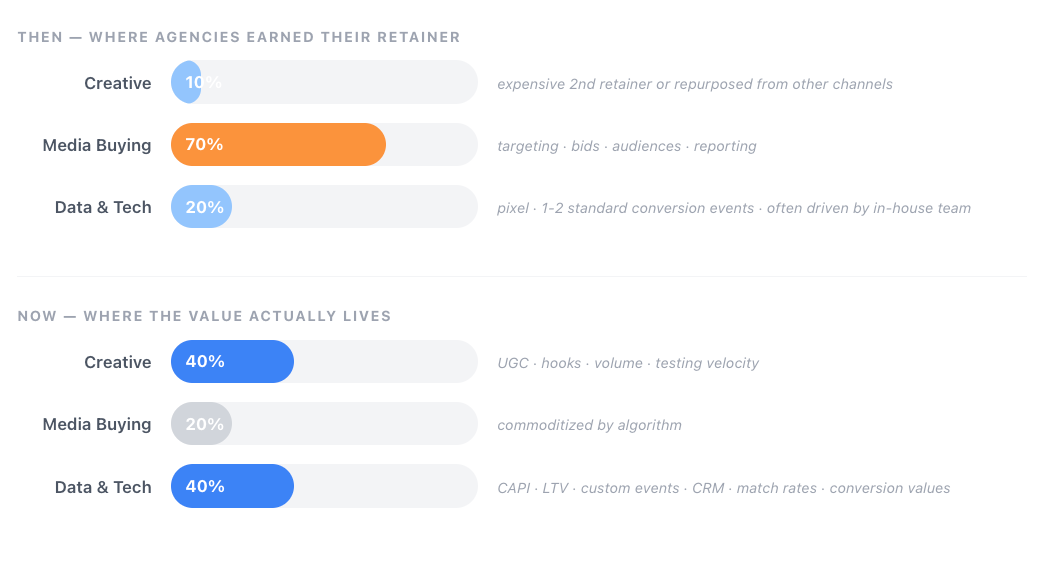
Where the Value Has Actually Migrated
The juice has moved up and down. The middle is dead.
Up → Creative
Go look at the ads that brands were running five years ago. I’ll wait.
Painful, right? Text-heavy static images that looked like they were made in Microsoft Paint. Expensive, highly-produced brand videos that felt like repurposed TV commercials — because they were!! None of it felt native to Instagram feed. None of it felt authentic.
Now look at what the best-performing brands are running today. Dozens of UGC creators. Dozens of angles. Rapid-fire hook testing and reverse-hook testing. Raw, native-feeling content that blends into the feed before it punches you in the face with an offer. UGC-style video ads are outperforming traditional creative by 30-40% in CTR, and reducing CPA by 25-50% in many cases. The UGC production market literally grew 69% year-over-year from 2024 to 2025 — from $4.5B to $7.6B globally.
This is where the creative leverage is. Not in a pretty brand video. In volume, variety, and velocity.
Down → Data & Tech
This is the other layer agencies have historically ignored, and it’s now where some of the biggest performance gains live. The fundamental idea is that now that targeting is mostly-controlled by the algorithm, we need to feed the algorithm as many quality signals as possible.
A few tried-and-true levers that improve CAC:
Server-side conversions (Conversions API / CAPI). If you’re still relying purely on client-side pixel tracking, you’re flying blind. iOS changes, browser restrictions, and cookie deprecation have made the browser pixel unreliable. Brands implementing CAPI report 15-20% improvement in campaign performance and a 44% increase in lead conversion rate versus standard lead ads. The reason: better signal quality going back to Meta’s optimization engine.
Event match quality. It’s not just about sending the conversion event — it’s about how well Meta can match it back to a user. Event Match Quality (EMQ) scores of 8+ — achieved by sending enriched fields like hashed email, phone, zip code, state — can yield 20-40% higher conversion accuracy. Most brands are sitting at a 4 or 5 and leaving massive money on the table.
Passing down-funnel signals. I see way too many agencies optimizing for the first step in the conversion funnel (i.e. Leads or Purchases). The real unlock is passing signals about which customers are actually good: LTV, subscription retention, deal size.
This is a huge needle-mover for longer funnels: at Coding Dojo (coding bootcamp, helped 3x revenue and get acquired), one key unlock was switching Meta from optimizing for lead form submissions to optimizing for sales-call-meeting-show-ups. That was a lot more work. But it drove a double-digit improvement in CAC because it helped the algorithm focus on quality.
LTV - You can pass total LTV for a user (not just the value of this purchase). And there are now a coterie of third-party tools that can pass a “predicted LTV” by enriching the user data. This helps Meta optimize toward your best customers, not just your most conversions.
True down-funnel attribution outside the ad platform. Pulling campaign, ad set, and ad-level data through to your CRM, Data Warehouse, and BI tools so you can measure actual revenue, true LTV, and payback period — not just platform-reported ROAS. The ad platforms double-count (i.e. Google and Meta both take credit for the same conversion).
The only solution is to have your own attribution data. And a good agency partner will help make sure you’re setting up Google Tag Manager, GA4, UTM parameters, and your CRM so that having your own attribution data is possible.
Your Renegotiation Playbook
Okay, so here’s where I’m going to give you the cheat sheet. If you’re renewing with your agency — or shopping for a new one — these are the specific terms to push on.
On Creative:
Strategy without execution is worthless. If your agency is currently charging you to develop a creative strategy brief but isn’t actually making the ads — cut that line item immediately. That’s just a Claude PowerPoint deck you’re paying for.
If they do have in-house UGC creative execution capabilities, push them to throw a meaningful amount of that into the base retainer. Don’t let it live as a $10K/month add-on.
If they won’t budge on that, consider a different mental model: freelance media buyer + UGC creative studio.
Get competitive quotes from dedicated UGC studios — there are good ones that’ll produce 10-15 pieces of content a month for $2-3K more than what you’re paying for that strategy deck.
On Tech & Data-Plumbing:
Here are some plays that will drive efficiency. If your agency hasn’t been owning these things — push back hard:
Setting up new events
CAPI (server-side conversions)
Passing more data like city, state, zip
improving event match rates
piping exclusion and retargeting audiences in directly from the CRM
Passing down-funnel data like meetings completed or LTV
Measuring CAC, ROAS, Paypack period down to the channel, campaign, and adset level
And expect them to own integrating ads with your CRM. If they’re 100% relying on in-platform data, they’re not doing their job.
So Do You Even Need an Agency?
The answer isn’t no. But the job description has completely changed.
The agencies that survive this shift aren’t media buying shops. They’re creative production studios with a strong data and measurement spine. If your current agency is primarily defined by its ability to manage Ads Manager — you are funding a dying agency. Like Blockbuster in 2007. You can see the writing on the wall if you squint.
What you want is an agency that can: (a) produce high volumes of native, UGC-style creative at speed, (b) own your measurement infrastructure end-to-end, and (c) use media buying not as the main event but as the operational layer that connects creative and data together.
Everything else is overhead.
P.S. — This Isn’t Just a Meta Problem
Everything I just described? It’s happening in Google Ads too.
Five years ago, keyword strategy was its own dark art. Exact match keywords, negative keyword lists, match type discipline — a good SEM manager could meaningfully outperform a mediocre one just by knowing how to structure a campaign. You paid for that expertise.
Today, Google is pushing everyone toward broad match + Smart Bidding, and the data increasingly backs them up. Broad match with a solid conversion signal now routinely outperforms tightly sculpted exact match structures. Google’s own internal studies show broad match driving 35% more conversions at a similar CPA when paired with Target CPA or Target ROAS bidding. Match type obsession has become a bit like debating seating arrangements on the Titanic.
And then there’s Performance Max. P-Max is Google’s version of Advantage+ — a fully automated campaign type that cuts across Search, Display, YouTube, Gmail, Maps, and Shopping simultaneously. The lever you actually control? The quality and variety of your creative. Sound familiar?
The agencies that used to differentiate on keyword architecture and bid management are facing the same existential question their Meta counterparts are. And the answer is the same: the value is in creative and in data. Everything else is getting automated out from under you.
Running paid Meta or Google for a client and want a second opinion on where your agency is actually creating value? Hit me up.